Sunday, July 17, 2011

PHYSIOLOGY TUTORIAL


Human aging can be stopped by adding telomerase: comment
We may think that, human aging can be stopped by adding telomerase but, telomerase causes cells to divide rapidly and uncontrollably. Such an excessive cellular proliferation may leads to cancerous growth. So you can’t expect telomerase to become the elixir of your youth.
At the ends of each chromosome is a non functional strand of DNA called telomere. It has been observed experimentally that telomeres shorten with each successive cell division. Shortened telomeres activate a mechanism that prevents further cell multiplication. When telomeres become too short, the cells die.
In 1965, Leonard Hay flick discovered the Hay flick limit-phenomenon-is a number of times a normal cell divide before the telomere reaches critical length.
Somatic cells can only divide around 30-50 times due to Hay flick effect. On the other hand germcells, stemcells and cancerous cells (considered immortal –in the sense that they can reproduce indefinitely) contain telomerase that prevents Hay flick limit. This enzyme extends the telomere of chromosome and prevents shortening of telomere.

PHYSIOLOGY TUTORIAL


PHYSIOLOGY-REASONING OUT
Hormones responsible for growth are sexually dimorphic
Yes, the statement is correct.
Sexual dimorphism means difference in forms between males and females of the same species. In animals that have separate sexes, males and females will always different, but in highly dimorphic species,2 sexes look very different and are often quite unequal in size.
Sex differences in the pattern of circulating somatotropin (ST) and circulating concentration of IGF (insulin like growth factor) and IGF-binding protein were demonstrated in rapidly growing prepupertal animals.The differences are consistent with the hypothesis that the somatotropic axis is a mechanism mediating sex differences in growth.Differences in circulating pattern of these hormones may arise from the actions of steroids during sexual differentiation and before puberty.
Several hypothalamic nuclei are sexually dimorphic i.e. there are clear difference in both structure and function between males and females. Some differences are apparent even in gross neuroanatomy.most notable is the sexually dimorphic nuclei within the preoptic area which is larger in males.(greater cell number and larger cell size in males).However most of the differences are subtle changes in the connectivity and chemical sensitivity of particular sets of hormones. The importance of these changes can be recognised by functional difference between males and females. For example secretion of GH is sexually dimorphic and this is one reason why in many species, adult males are much larger than females. and estrogens sensitive neuron in hypothalamus is sexually dimorphic.

Saturday, July 9, 2011

PHYSIOLOGY TUTORIAL


PHYSIOLOGY SECRETS
Blood flow through the Reconditioning organs should be supplied constantly and adequately: comment
Ans-No.not necessary. Reconditioning organs like G.I.T, skin and kidney can tolerate significant reductions in blood flow for a considerable length of time. Because they receive blood flow in excess of their own needs. They can withstand temporary reductions in blood flow much better than other organs (heart and skeletal muscle) that do not have this extra margin of blood supply, brain in particular suffer irreparable damage when transiently deprived of blood supply. During exercise some of the blood that normally flows through G.I.T, kidney is diverted instead to skeletal muscle. Likewise blood flow through skin is markedly decreased during exposure to cold to conserve heat.

Monday, June 27, 2011

Physiology secrets


PHYSIOLOGY SECRETS
Beyond Mendel’s law (variation in Mendelian genetics)
There are 2 common variations.
1. Blood types-Mendel studied, each character is determined by a gene with 2 alleles, i.e 2 alternate forms. But in blood types ,unlike the genes Mendel studied, which had only 2 alleles, the blood type gene I exists in 3 distinct forms. The 3 alleles are IA, IB, IO.The A and B alleles are co-dominant, and both are completely dominant to O.However, even though 3 possible alleles in human, an individual can have only 2 of the alleles in his or her genes. And 4 possible blood types exist.
2.Maternal inheritance and Mitochondrial genes- The basis of the law of segregation is that both parents contribute genes equally to offspring. But in the case of mitochondria, it is interesting to note that the genes in the mitochondria are inherited only from mother. Why not from father? Because mitochondria are located in the middle of the sperm not in the head region that enter the egg. In rare instances, when mitochondria from sperm enter an oocyte they are destroyed selectively early in embryonic development.

Friday, June 24, 2011

physiology secrets


PHYSIOLOGY SECRETS
Reasoning out: Single gene traits obey All or None Law-comment
Yes. Single gene traits are discrete or qualitative and providing All or None phenotype (normal vs. affected) instead multiple genes that regulate height, skin colour-result in continuously varying phenotype. (Skin colour is controlled by 8 genes)Both single gene and polygenic traits can also be multifactorial i.e. they are influenced by environement.pure polygenic not influenced by environment are rare. (Eye colour-polygenic not environmental)

Monday, March 28, 2011

physiology secrets


PHYSIOLOGY SECRETS
What is Hill’s hyperbola? How it is applicable in muscles? Compare and apply it for different kinds of muscles in our body.
Ans-Hyperbola is an open curve and it continues indefinitely to infinity. It is related to F-V (force-velocity curve) of muscles.
Skeletal muscle-F-V curve shows inverse relation between velocity of shortening and force (after load). (Fig-1)
Vmax(maximum velocity of shortening.)If no load is applied, the muscle will shorten at its greatest possible speed, a velocity known as Vmax.in this graph the value is extrapolated bcz muscle cannot contract in the absence of any load. (Fig-1)
Y-intercepts represent extrapolated value for maximum velocity-Vmax.Algebrically Y intercepts is a point where X is zero.
Fmax i.e. Po :( Maximum isometric force).represents the point where after load is so great that the muscle cannot shorten.
X-intercepts is a point where Y is zero.
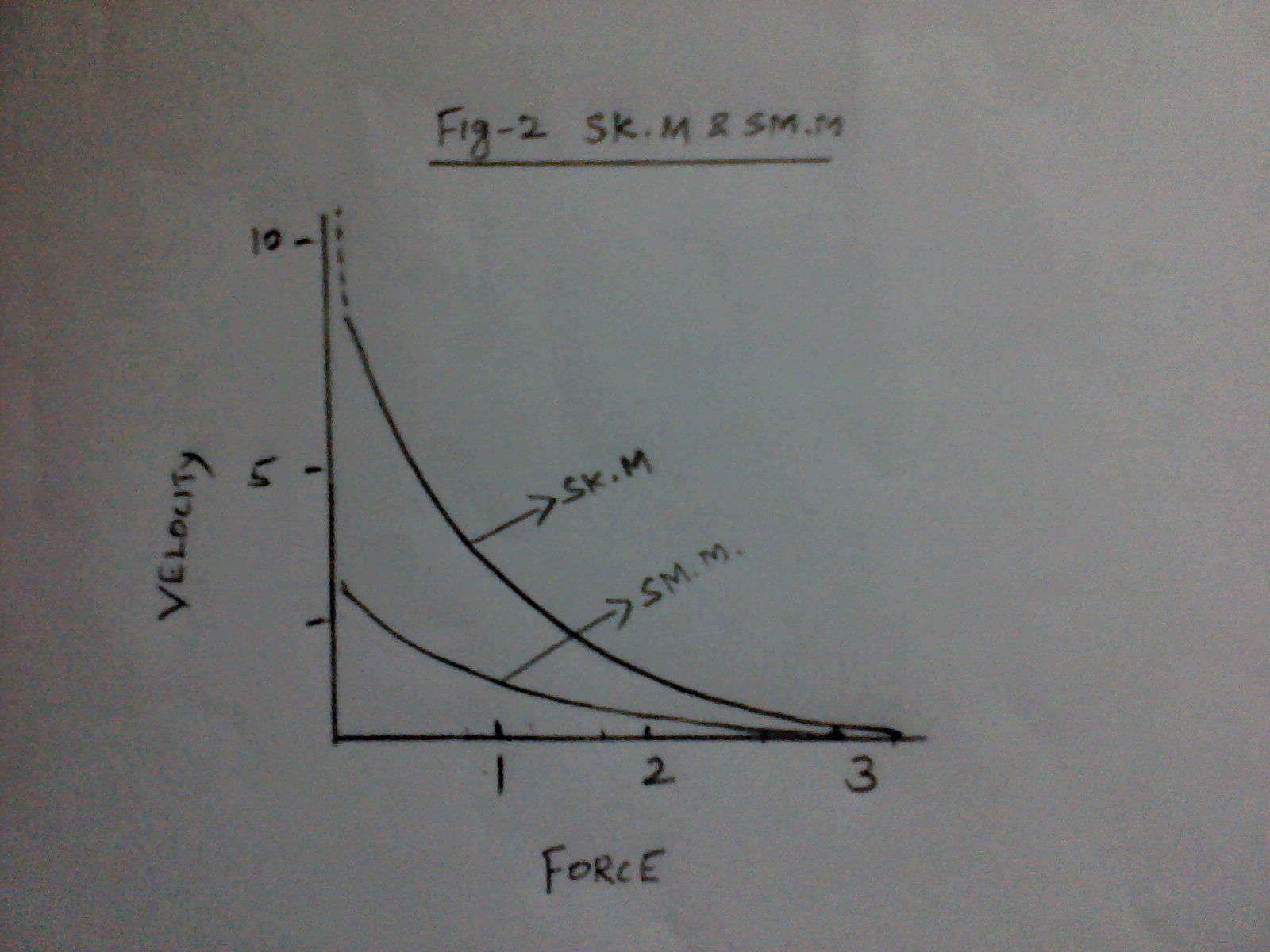
Smooth muscle’s F-V curve is compared with skeletal muscle. (fig-2) here the peak force may be similar but velocity of shortening is 100 times lower than skeletal muscle.
Cardiac muscle-F-V curve is influenced by changes in initial length (preload) and the changes in the contractility. (Fig3-A, 3-B)
If preload is increased (within physiological limits) Fmax increases, as well as velocity of shortening, but doesn’t alter the Vmax. (Fig-3-A)
Changes in ionotropism also alter the F-V.If ionotropic effect of cardiac muscle is increased, there is parallel shift up and right and increase in both Fmax and V max. (Fig 3-B).

Sunday, March 27, 2011

PHYSIOLOGY TUTORIAL


Physiology tutorial
REASONING OUT/COMMENT
Q) Citric acid and ascorbic acid tend to acidify the blood and urine.
Ans: wrong.they cause alkalinisation of blood and urine, bcz mostly they exists in anionic form and are metabolized to Hco3.Acidification will only occur if it is excreted unmetabolized.